On this page · 8 sections
Many people who book a sailing trip in Barcelona have never stood on the deck of a sailing boat before. That is exactly how a skippered trip is meant to work: a skipper runs the boat, and you decide how involved you want to be. Sailing in Barcelona without experience needs nothing more than comfortable shoes, a spare layer and a willingness to enjoy the sea.
This guide explains what the skipper looks after, what beginners can try if they want to, a little vocabulary that helps on board, and how a guided trip differs from a sailing course.
Sailing without experience: the short answer
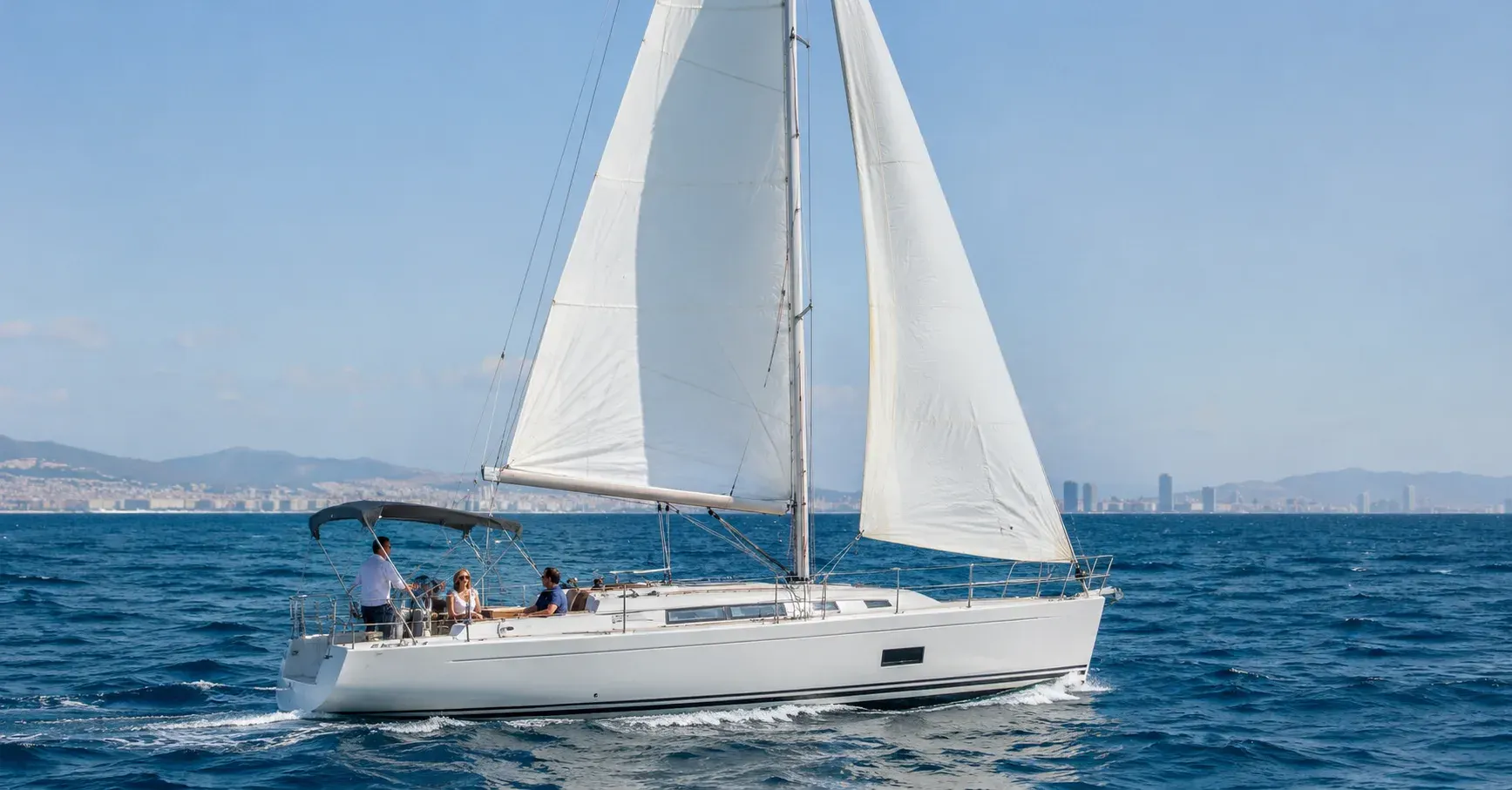
You do not need to know anything about boats. Every experience we offer runs with a skipper on board, so the sailing, the navigation and the safety decisions are handled for you. You can spend the whole trip on deck watching Montjuïc, the port cranes and the long line of Barceloneta slide past.
If you are curious, there is usually room to get your hands on the boat. The skipper may invite you to steer for a while or help trim a sail, but only when conditions are right and never as an obligation. That balance is what makes sailing in Barcelona without experience relaxed rather than a test.
What the skipper handles on a beginner sailing trip
A sailing boat needs a steady stream of small decisions, most of which guests never notice. On every trip the skipper takes care of:
- Leaving and returning to the berth. Manoeuvring in a busy marina is the part that takes the most practice, and it is always done by the skipper.
- Harbour traffic. The waters around Port Vell and the harbour mouth are shared with sightseeing boats, pilot boats, fishing boats and other yachts. The skipper knows the channels and who gives way to whom.
- Raising, trimming and lowering the sails. How much sail to set depends on the wind on the day, and that can change within an hour.
- The route. Where to sail depends on the wind direction, the sea and what will be comfortable for the people on board, so the plan is made on the day.
- Safety and weather. The skipper gives the safety briefing, keeps an eye on the sky and the water, and decides whether conditions are suitable.
That last point matters most. Because a professional is in charge, a beginner’s only real job is to follow a few simple instructions, such as holding on as you move and keeping your head clear of the boom.
What you can try if you want to
Every skipper and every day is different, so read this as what guests can often try rather than a list of promises. Wait until you are out on open water, ask, and the skipper will say what makes sense in that moment. This is where beginner sailing in Barcelona gets fun.
Taking the helm
Steering is the favourite. Depending on the boat you hold a wheel or a tiller and keep the bow pointed at a landmark the skipper chooses, perhaps the twin towers of Port Olímpic or the sail-shaped W hotel at the end of the beach. You soon feel that a sailing boat answers slowly and smoothly, more like a bicycle at walking pace than a car.
Pulling in a sail
The ropes that control the sails are called sheets. On larger boats they wrap around a winch, a drum turned with a handle that gives you the leverage to pull them in. Helping trim a sail is a good way to feel the real power of the wind, and the skipper will show you how to keep your fingers out of the way.
Helping with a tack
A tack means turning the bow through the wind so the sails swap sides. It takes a few coordinated moves: one person steers, one releases a sheet, another pulls in the opposite one. With a willing crew the skipper can talk everyone through it, and groups tend to enjoy the small piece of teamwork, which is why it also features in our ideas for team building on the water.
Reading the wind
Even without touching anything you can learn to read the breeze. Watch the short ribbons on the sails, called telltales, notice which side of your face the wind is on, and feel the boat pick up speed when the skipper trims. It is the quiet skill underneath everything else.
| What you can try | What it involves | Usually when |
|---|---|---|
| Steering | Holding a course towards a landmark | Open water, steady wind, little traffic |
| Trimming a sail | Pulling in or easing a sheet, sometimes on a winch | When the skipper adjusts to the wind |
| Tacking | Turning through the wind as a small team | When the route needs a change of direction |
| Reading the wind | Watching telltales and the surface of the water | Any time on the trip |
Good to know: Tell us on WhatsApp if you would like a more hands-on trip. We cannot promise how much you will do, because that depends on the wind and the sea on the day, but the skipper will know to offer.
A common first question: do I need sailing experience?
The honest answer is no, and it is not a sales line. Someone who has never been on anything bigger than a ferry and someone who owns a boat at home can share the same deck, because the skipper adjusts to whoever is on board.
So rather than wondering whether you need sailing experience, it is more useful to ask whether you are comfortable on a gently moving surface for a while. If motion sickness worries you, read our seasickness tips before you go. If the thought of the boat leaning makes you nervous, our walk-through of your first time on a sailing boat explains what heeling feels like and why it is normal.
What you genuinely do not need
- Knots. The skipper ties everything that matters.
- Special kit. Flat, soft-soled shoes and a layer for the sea breeze are enough.
- Great fitness. You need to be able to step aboard and move carefully around the deck, nothing more.
- Prior confidence. Feeling a little nervous on a first sail is completely normal, and a good skipper expects it.
A skippered trip versus a sailing course
The two are easy to confuse, but they are different things.
A skippered trip is a guided experience. You book time on the water with a professional in charge, and any sailing you do is a taste of it rather than a lesson plan. There are no exams and no certificate at the end.
A sailing course is structured training at a sailing school, spread over several sessions or days with a syllabus. In Spain, people who want to take charge of a boat themselves usually work towards a recreational licence, such as the PNB (Patrón de Navegación Básica), which involves study and practical sessions.
| Skippered trip | Sailing course | |
|---|---|---|
| Who sails the boat | The skipper, with your help if you want | You, under an instructor |
| Main aim | Enjoying the sea and the view of the city | Learning skills step by step |
| Time needed | One trip | Several sessions or days |
| What you leave with | A good day out and a feel for sailing | Progress towards a qualification |
| Licence needed | None | None to start; the course builds towards one |
If your real plan is to hire a boat and sail it yourself, our page on renting a boat in Barcelona explains skippered hire, bareboat hire and the licence question in plain language. We do not offer bareboat hire: every boat we run sails with a skipper, and we will tell you honestly if what you are after is a course rather than a sail with us.
A little sailing vocabulary
You will hear a handful of words on board. None are required, but knowing them makes the skipper’s instructions easier to follow.
- Bow and stern: the front and the back of the boat.
- Port and starboard: left and right when you face the bow. A handy memory aid is that “port” and “left” both have four letters.
- Helm: the wheel or tiller you steer with.
- Boom: the horizontal pole along the bottom of the mainsail. When you hear “mind the boom”, keep your head low.
- Heel: the lean of the boat as the wind fills the sails. The hull is designed for it.
Barcelona conditions for first-timers
Local conditions make sailing in Barcelona without experience fairly forgiving. The city faces the open Mediterranean, where tides are tiny, and in the warmer months a regular afternoon breeze often builds off the sea as the land heats up. Catalans call it the marinada. Mornings and early evenings are frequently gentler, which suits nervous guests, while a fresh afternoon breeze gives a livelier sail if you want to feel the boat move.
Winter brings clearer air and fewer boats on the water, but a colder wind on deck and, on some days, stronger gusts. Whatever the month, the skipper makes the call on the day. Our sailing weather guide explains how wind and waves change the feel of a trip.
Choosing your first sail
For a first taste, a standard sailing trip out of Port Vell is the simplest place to start. If you want the skipper’s attention for your own group, with more chances for each of you to try the helm, a private boat trip makes more sense. When you are ready to sort the details, from picking a date to the morning itself, follow our step-by-step planning checklist.
Trips leave from the Plaça de Pau Vila area in front of the Palau de Mar, a short walk from Barceloneta metro station on line L4. Message us on WhatsApp, say you are new to sailing and if you would like to try steering, and we reply with the options for your date, the price, the timing, what is included and the cancellation terms in writing.