On this page · 10 sections
Barcelona has always lived from the sea, even though nature gave it a poor harbour. There was no deep, sheltered bay here, only an open beach, so almost everything you see around Port Vell today was built by hand over several centuries. This short guide to Barcelona’s maritime history follows that story from the medieval shipyards to the harbour our boats leave from.
Read it before you sail and the waterfront starts to make sense: each building marks a chapter of the city’s maritime story, and most of them face the water.
A harbour the city had to build
For much of the Middle Ages ships anchored off the beach and cargo was ferried ashore in small boats. Storms from the east could wreck vessels at anchor, and the sand kept shifting. From the 15th century, with royal permission, the city began work on a proper breakwater, and the harbour grew outwards in stages from there.
That slow, expensive effort explains the shape of the port. The old harbour sits behind a long arm of man-made quays, and the modern commercial port has kept pushing south ever since. The history of Barcelona’s port that you can read in the stonework is really a history of engineers fighting the open sea.
The medieval trading city
Between the 13th and 15th centuries Barcelona was a leading port of the Crown of Aragon, whose ships traded and fought across the western Mediterranean, from Sicily and Sardinia to Naples. Merchants grew rich on cloth, coral, spices and grain.
Two institutions from that era still stand. The Llotja de Mar, the merchants’ exchange on Pla de Palau, kept its great Gothic trading hall even after a later neoclassical facade was added. And the Consolat de Mar, the sea-trade court of the Crown of Aragon’s ports, gave its name to a medieval book of maritime customs that was used across much of the Mediterranean, covering matters from cargo disputes to the duties of a ship’s master.
The Drassanes Reials
At the foot of La Rambla stand the Drassanes Reials, the royal shipyards. Work began in the 13th century and the halls were extended several times. Their long parallel naves, under high stone arches, let shipwrights build war galleys under cover, protected from rain and sun, and launch them straight onto the beach that then lay in front.
Shipbuilding there faded over the centuries, and the halls later served the army as barracks and stores before the museum moved in during the 20th century. Today the shipyard complex holds the Museu Marítim, Barcelona’s maritime museum. Its centrepiece is a full-size replica of the royal galley that led the Christian fleet at the Battle of Lepanto in 1571, and the museum also looks after the Santa Eulàlia, an early 20th-century schooner usually moored at the Moll de la Fusta.
Good to know: The museum is a short walk from the Columbus column and from Drassanes metro station (L3), so it fits easily before or after a sail. Check opening times on its official website before you go.
Columbus and the column
In 1493, back from his first voyage across the Atlantic, Christopher Columbus travelled to Barcelona to report to Ferdinand and Isabella, who were holding court in the city. Four centuries later Barcelona marked that visit with the Mirador de Colom, built for the 1888 Universal Exhibition.
The column rises around 60 metres above the roundabout at the bottom of La Rambla, and the statue on top points out to sea. A small lift takes visitors up to a viewing gallery. From the water it is one of the first landmarks you notice, as our checklist of landmarks seen from a boat explains.
Barceloneta: a quarter built for the sea
After the siege of 1714, the new authorities built the Ciutadella fortress on the eastern edge of the old city and demolished part of the Ribera neighbourhood to make room. In the mid-18th century military engineers laid out Barceloneta on sandy land that had built up beside the harbour, a move often explained as rehousing those families.
The result was the grid of narrow streets and small blocks you still see behind the beach. For generations it was a quarter of fishermen, sailors and port workers. The Torre del Rellotge, an old lighthouse turned clock tower on the fishermen’s wharf, still watches over the boats. To see how the quarter looks from offshore, read our guide to Barceloneta from the water.
The industrial port
The 19th century turned Barcelona into the industrial capital of Spain. Textile mills spread across Poblenou, and the first railway in mainland Spain opened along the coast to Mataró in 1848. The port filled with steamships, coal and cotton.
The great warehouse now known as the Palau de Mar belongs to this era, built as general stores for the port. The Moll de la Fusta, the “timber wharf”, took its name from the wood unloaded there. By the mid-20th century a wall of rail tracks, sheds and roads separated the city from its own seafront.
1992: the city turns back to the sea
The 1992 Olympic Games changed that. Traffic went into the coastal ring road, the railway was moved, and the beaches north of Barceloneta were rebuilt and opened to the public. Port Olímpic was created for the sailing events, flanked by two new towers.
In Port Vell, the old commercial quays became public space: the redesigned Moll de la Fusta, the Palau de Mar converted into the Museu d’Història de Catalunya, and, in the years that followed, the Rambla de Mar footbridge, the Maremagnum centre and the Aquàrium. The square in front of the Palau de Mar, Plaça de Pau Vila, is where our sailing trips meet. Our Port Vell guide covers the area as it is today.
The port of Barcelona today
The working port has moved south. Container and cargo terminals now stretch south towards the mouth of the Llobregat river, which was diverted in the 2000s to let the port expand, and most large cruise ships berth along the outer breakwater. Barcelona is today one of the busiest cruise ports in the Mediterranean.
The old harbour, meanwhile, has become a leisure port with marinas for yachts of every size. In 2024 the city hosted the America’s Cup, with racing just off the beaches, a reminder that sailing is still part of local life.
Timeline of Barcelona’s port history
| Period | What happened |
|---|---|
| 13th–15th centuries | Drassanes Reials built and enlarged; Barcelona trades across the Mediterranean |
| Middle Ages | Consolat de Mar book of sea customs in use across the Mediterranean |
| 15th century | Work begins on a proper breakwater |
| 1493 | Columbus reports to the Catholic Monarchs in Barcelona |
| Mid-18th century | Barceloneta laid out beside the harbour |
| 1848 | Railway opens along the coast to Mataró |
| 1888 | Columbus column built for the Universal Exhibition |
| 1992 | Olympic Games reopen the seafront; Port Olímpic built |
| 2000s | Llobregat diverted; commercial port expands south |
| 2024 | America’s Cup races off Barcelona |
Seeing Barcelona’s maritime history from the water
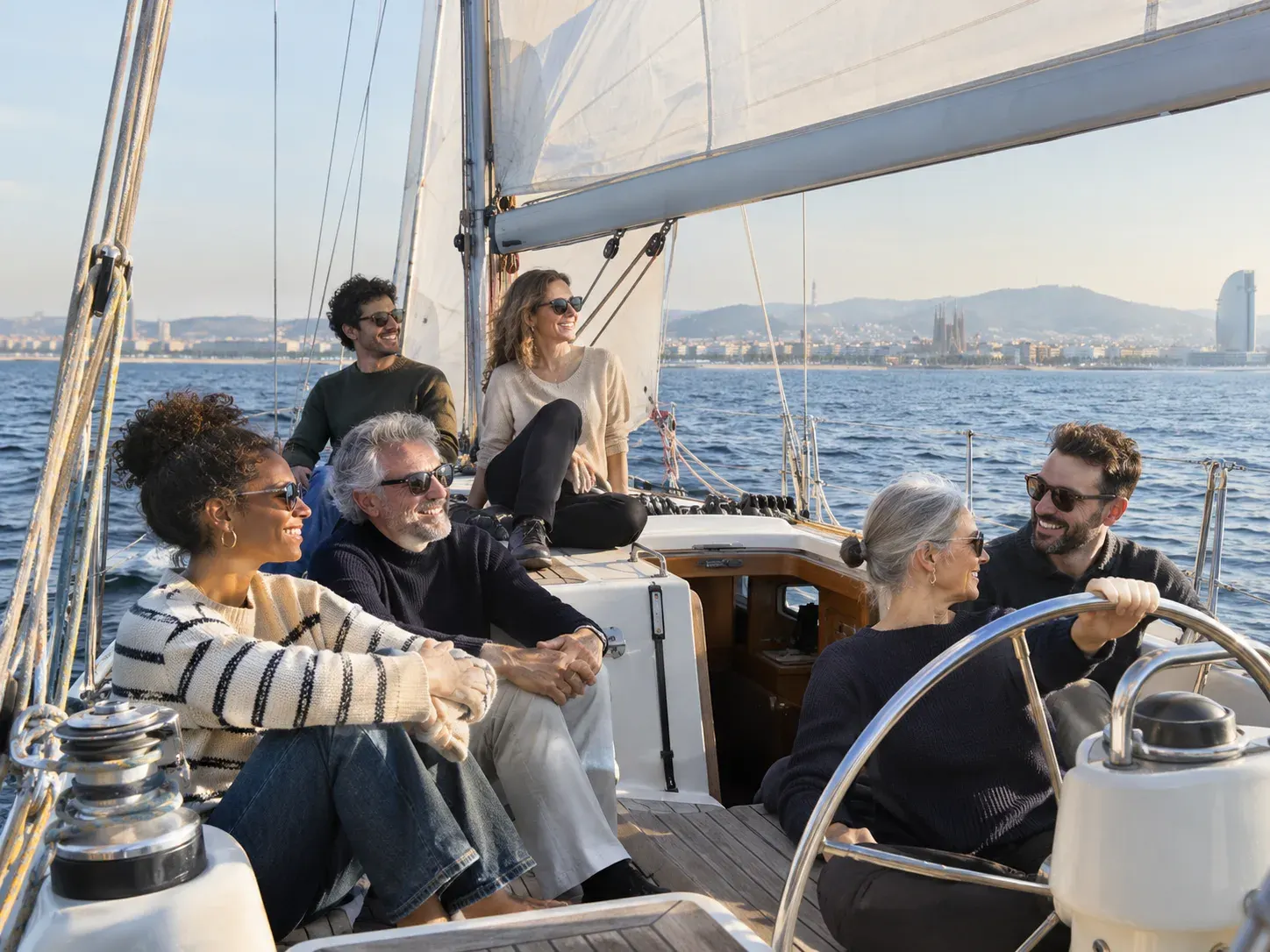
The best way to connect these chapters of Barcelona’s maritime history is to see them in one sweep: the shipyards and column at the foot of La Rambla, the warehouses of the 1800s, the fishermen’s quarter and the Olympic towers beyond. A sail out of Port Vell shows all of it in order, depending on the route the skipper chooses for the wind that day.
If you want to add a museum or a walk, our list of things to do near Port Vell is a good start, and the overview of our sailing tours explains the trips we run. Message us on WhatsApp with your date and we will reply with the options, the timing and the price in writing.