On this page · 10 sections
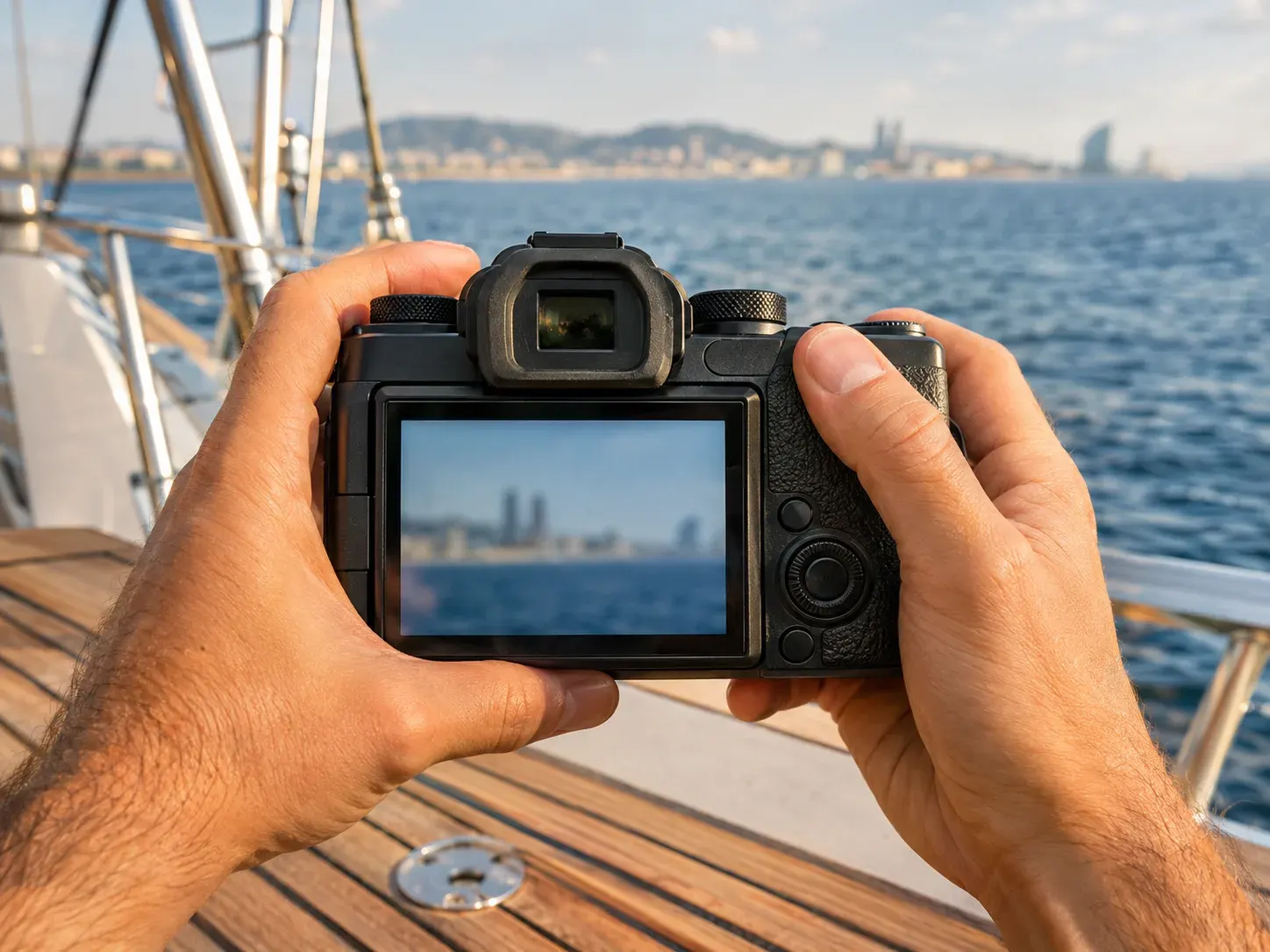
A boat is one of the most rewarding camera platforms in Barcelona and one of the most awkward. You get an open view of the whole skyline, light bouncing off the water and no crowds in the frame, but the deck keeps moving, the wind tugs at everything and salt spray finds its way onto every lens.
These boat tour photography tips cover what actually makes a difference on a sailing boat: the settings, the way you stand, and how to bring your phone or camera home dry.
The short answer
Sharp photos at sea come from three habits. Use a fast shutter speed, so the boat’s motion does not blur the picture. Brace your body against the boat, not just your hands against the camera. And straighten the horizon before you shoot, because a tilted sea looks wrong in a way a tilted street does not.
The rest of these boat tour photography tips expand on those three ideas.
Why photos on a boat go wrong
On land, the ground stays still and you are the only thing moving. On a boat, three things move at once: the hull rolls from side to side, it pitches forwards and back over the waves, and you sway on top of both. A sailing boat also heels, leaning steadily to one side when the wind fills the sails.
Most disappointing boat photos fail for one of four reasons:
- Motion blur from a shutter that was too slow for the movement.
- Wonky horizons, because the boat was leaning when the photo was taken.
- Hazy, low-contrast images from salt or fingerprints on the lens.
- Blown-out skies or dark faces, because bright water fooled the light meter.
Each has a simple fix.
Camera settings for a moving deck
Shutter speed
Treat 1/500 of a second as your starting point for general shots on deck, and go to 1/1000 or faster with a zoom lens or a choppy sea. If your camera has shutter priority mode (S or Tv), use it and let the camera choose the rest. Image stabilisation helps, but it is designed for hand shake, not for a whole boat moving under you.
Aperture and ISO
In bright daylight, a mid aperture such as f/8 gives you plenty of depth and keeps both the deck and the city reasonably sharp. As the light fades, open the aperture first, then raise the ISO. A slightly grainy evening photo is far better than a blurred one, so do not be shy with auto ISO.
Focus
Continuous autofocus (AF-C or AI Servo) copes better with a moving boat than single-shot focus. For faces on deck, use eye or face detection if your camera has it. For the skyline, focus on something with clear edges, such as a tower or the port cranes, rather than open sky or water.
Exposure on bright water
Sunlight on the sea can trick the meter into underexposing faces. Dial in a little exposure compensation (+0.3 to +0.7) for portraits against the water, or meter from the person’s face. For skylines and sunsets, do the opposite and expose for the sky.
Keeping the horizon level
A level horizon is the single quickest way to make sea photos look professional. Switch on the grid lines or the electronic level in your camera or phone, then line the horizon up with a grid line before you shoot.
Because the boat heels and rolls, wait for the moment the deck passes through level, then press. If you miss it, you can straighten the picture afterwards, but every degree of rotation crops away part of the frame, so get as close as you can at the time.
Placing the horizon on the upper or lower third of the frame, rather than through the middle, also gives a stronger picture: low for a dramatic sky, high for patterns on the water.
Phone photography on a boat
Most people on a boat trip shoot on a phone, and a phone is genuinely good at this. Some phone photography on a boat habits make it better:
- Lock focus and exposure. Press and hold on your subject until the lock appears, then adjust brightness with the slider.
- Use burst mode for moving subjects or when the boat is rocking, then keep the sharpest frame.
- Avoid digital zoom. Use the phone’s dedicated telephoto lens if it has one; otherwise get the wide shot and crop later.
- Turn off the flash. On deck it only lights up spray and reflections.
- Shoot video in short clips. Ten-second clips are easier to steady and edit than one long recording.
- Wipe the lens often. A soft cloth in your pocket does more for image quality than any setting.
Portrait mode works for faces on deck, but it can struggle with hair blowing in the wind and with rigging behind people. If edges look strange, switch back to the normal camera.
How to take photos on a boat safely
The best photo is never worth a fall. When working out how to take photos on a boat, think about where you stand before you think about framing.
- Sit or kneel for low, steady shots. The cockpit is usually the most stable place on a sailing boat.
- Brace against something solid, such as a seat back or the cockpit edge, and keep your knees soft so they absorb the motion.
- Keep one hand for the boat when you move around. Only use both hands on the camera once you are settled.
- Stay clear of ropes and the boom. Lines move quickly when the sails are adjusted, and the skipper will tell you where it is safe to stand.
- Wear soft-soled, grippy shoes. A wet deck is slippery, and our guide on what to wear on a Barcelona boat tour covers the details.
If you want a specific angle, such as a shot from the bow, ask the skipper. They know when the boat will be calm enough to move forward.
Protecting your gear from spray and salt
Salt water is hard on electronics, and spray travels further than people expect. Even on a calm day a single wave against the bow can soak the front of the boat.
- Use a strap. A wrist or neck strap for your camera, and a lanyard or grip case for your phone.
- Bring a small dry bag or a simple zip-lock bag to store kit between shots.
- Choose your side. Spray mostly comes over the front and the side facing the wind, so shoot from the back of the boat when it is lively.
- Change lenses in a sheltered spot or not at all. Pick one versatile lens before you board.
- Clean afterwards. Wipe salt off with a soft, slightly damp cloth, then dry it. A dry tissue can drag salt crystals across the glass.
Pack a power bank too. Cold evenings and bright screens drain phone batteries faster than usual.
Barcelona light through the day
The city faces the sea to the south-east, which shapes the light from the water at every hour.
| Time of day | What the light does | What to shoot |
|---|---|---|
| Early morning | Low sun over the sea lights the waterfront from the front | Barceloneta, the port, the hills behind the city |
| Midday | High, hard light, deep blue water | Water colour, sails, deck details |
| Late afternoon | Sun sinks in the west, towards Montjuïc and the hills | Silhouettes, long shadows, warm skyline |
| After sunset | Soft blue hour and city lights | The lit harbour and the Columbus monument |
If light is your priority, the sunrise cruise puts the sun in front of the city, and our sunset photography guide goes deeper on the golden hour.
What to photograph from the water
Out at sea the city reads as one long skyline, so think in layers: the water in front, the waterfront in the middle and the hills behind. Sights you may be able to frame, depending on the route the skipper takes that day, include Montjuïc and its castle, the port cranes, the sail-shaped W Barcelona hotel, the twin towers of Port Olímpic, Frank Gehry’s fish sculpture and, on clear days, the spires of the Sagrada Família.
Our guide to the Barcelona skyline from the sea explains how to pick out each building, and the landmarks you can see from the water page adds some history to go with your pictures.
Do not forget the boat itself. Sails against the sky, a hand on the wheel, coiled ropes and the wake behind you often make better pictures than the skyline. For ideas on a trip built around photos, see sailing photography in Barcelona.
Good to know: Other guests may not want to appear in your photos, especially on a shared trip. Ask before you point a camera at people you do not know, and leave the drone at home unless you have checked the rules and asked us first.
Planning a trip with photography in mind
If photos are the main reason you are sailing and you want to put these boat tour photography tips into practice, tell us when you get in touch. A private boat gives you more say over the time of day and the general direction, within what the wind, the sea and the skipper’s safety judgement allow. On a shared trip the route serves everyone on board.
Send us your date and what you would like to photograph, and we will reply on WhatsApp with the options, the timing and the price in writing.


